Litter Prevention Program
Phone: (416) 321-0633
  • Home
    • This Week in 'Litterland' >
      • Current Edition
      • Past Issues by Date
    • Guide
    • Sheila's Blog >
      • Dear Diary
  • About
    • Get Involved >
      • Heroes
    • Program Brochure
    • Program Details
    • Press Release
    • What People Say >
      • Visitor Feedback
  • Media
    • Progress Report
  • News Reel
    • Summer 2024 >
      • Spring 2024 >
        • Winter 2023-'24
        • Fall 2023 >
          • Summer 2023
          • Jun 2023
          • May 2023
          • Apr 2023
          • Mar 2023 >
            • Feb 2023
            • Jan 2023
            • Dec 2022
            • Nov 2022 >
              • Oct 2022
              • Sep 2022
              • Aug 2022
              • Jul 2022
              • Jun 2022
              • May 2022
              • Apr 2022 >
                • Mar 2022
                • Feb 2022
                • Jan 2022
                • Dec. 2021
                • Nov. 2021 >
                  • Oct. 2021
                  • Sep. 2021
                  • Aug. 2021
                  • Jul. 2021
                  • Jun. 2021
                  • May 2021
                  • Apr. 2021 >
                    • Mar. 2021
                    • Feb. 2021
                    • Jan. 2021
                    • Dec. 2020 >
                      • Nov. 2020
                      • Oct. 2020
                      • Sep. 2020
                      • Aug. 2020
                      • Jul. 2020
                      • Jun. 2020 >
                        • May 2020
                        • Apr. 2020
                        • Mar. 2020
                        • Feb. 2020
                        • Jan. 2020 >
                          • Dec. 2019
                          • Nov. 2019
                          • Oct. 2019
                          • Sep. 2019
                          • Aug. 2019
                          • Jul. 2019
                          • Jun. 2019
                          • May 2019
                          • Apr. 2019
                          • Mar. 2019 >
                            • Feb. 2019
                            • Jan. 2019
                            • Dec. 2018
                            • Nov. 2018
                            • Oct. 2018
                            • Sep. 2018 >
                              • Aug. 2018
                              • Jul. 2018
                              • Jun. 2018
                              • May 2018
                              • Apr. 2018
                              • Mar. 2018
                              • Feb. 2018
                              • Jan. 2018
  • Litter Quiz
  • Photo Gallery
    • Video
    • Library
    • Butts and More Butts
    • Clean Up Days
    • Coffee Cups
    • Litter Photos
    • Poster
  • Prevent Litter
    • Causes
    • Solutions
    • Benefits
    • Tips >
      • For Business
    • Tobacco litter >
      • Fact Sheet
      • Letter to Imperial Tobacco
    • Resources >
      • Marine Litter
      • Plastics
    • Why Prevent Litter?
    • Toronto
  • Contact
    • Corporate Brochures
    • WORDS Media & Communications Inc.

NBA playoffs in Toronto a great chance to put waste in the basket

5/27/2019

1 Comment

 
Imagine this: An anti-litter campaign married to a big-time sporting event in one of the world’s greatest cities. 
 
The NBA Championship will hit Toronto this week for the first time starting Thursday night.  Is there no more natural a union for litter prevention than with a sport that involves putting something in a basket? 
 
McDonald's tried a two-week advertising campaign in Germany some years back in connection with world soccer and litter: Same idea, different sport.  It reaped results, a 62 per cent increase in bin usage over the course of the promotion. 
 
Scotland linked its national anti-litter initiative to the 2014 Commonwealth Games it hosted in Glasgow.
 
For Toronto, Ontario, where littering behaviors are prolific and, although unlawful, frequently go unchecked, this is an opportunity to target a demographic associated with littering: ages 18 to 35, and smokers.
 
An anti- litter campaign/contest would benefit everyone. Clean city, great environment, lower costs, higher property values, less crime.
 
The Toronto Raptors’ championship run has all the right elements for a superb awareness push: sports celebrities, corporate sponsors, a major league with an established fan base and social media channels, TV opportunities, community engagement possibilities, and an unbeatable theme, a natural tie-in: “Put It In The Basket”.   It presents the chance to involve partners like beverage, fast food, confectionery, packagers and others whose products contribute to the litter stream.

Other places hold little prevention contests, everything from trash can-painting for kids in Montana to car giveaways in Texas.
 
Texas gave away a car as part of a statewide anti-litter sweepstakes. University of Northern Tennessee student Justin Truby, of Denton, received the keys to his 2016 Ford Fusion SE Hybrid during a Dallas Cowboys - Washington Redskins game in front of a hometown stadium crowd in Arlington on January 3. It was a big deal, done to mark 30 years of “Don’t Mess With Texas”, a celebrated anti-litter campaign.
 
Encouraging people not to litter during the NBA finals in the City of Toronto would be akin to a slam-dunk for litter prevention, which doesn't receive the attention it deserves for a problem of its size. 
1 Comment

Ninety Minutes on a Sunday

4/7/2019

0 Comments

 
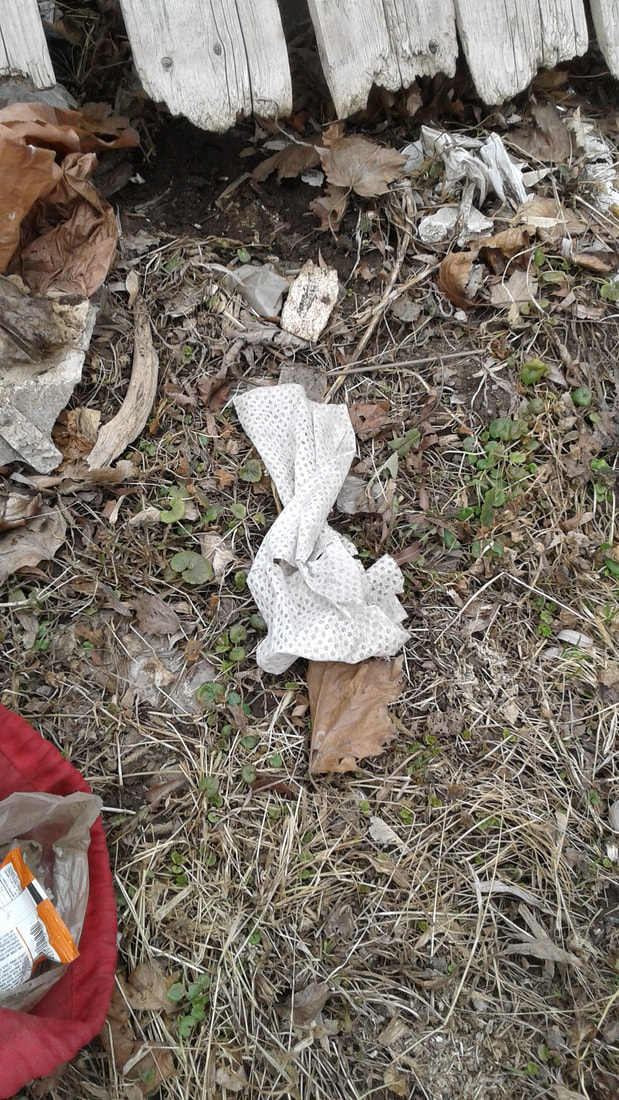
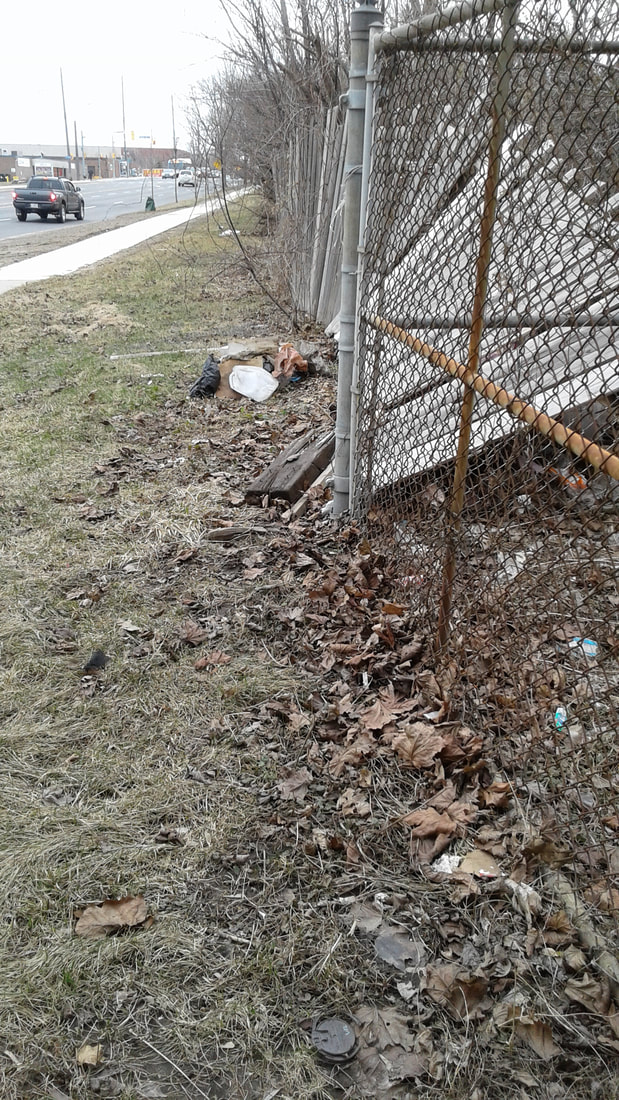
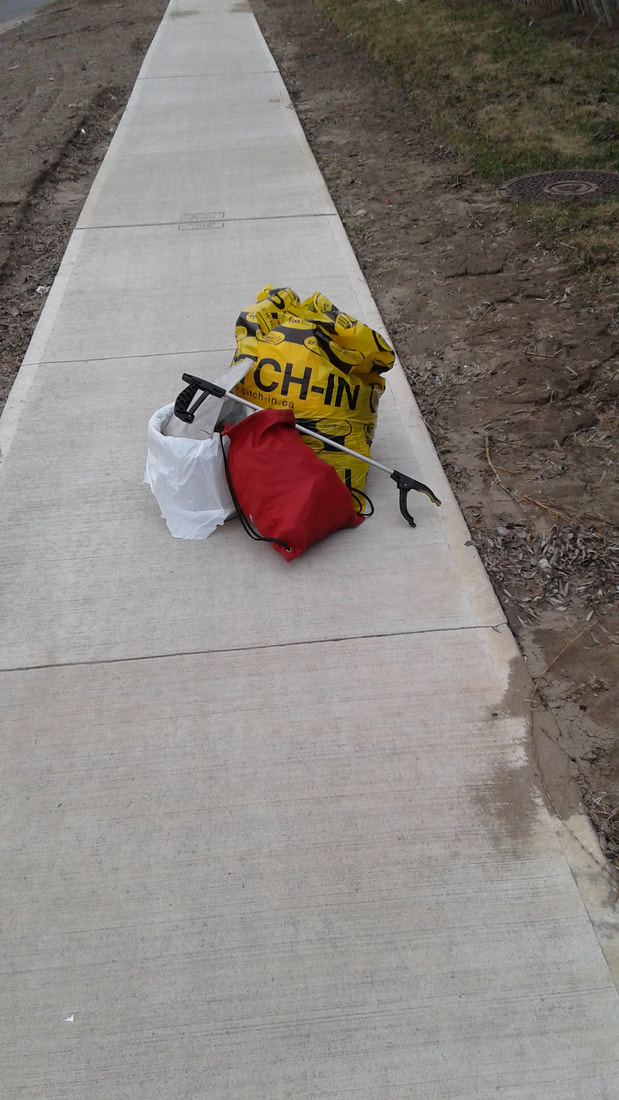
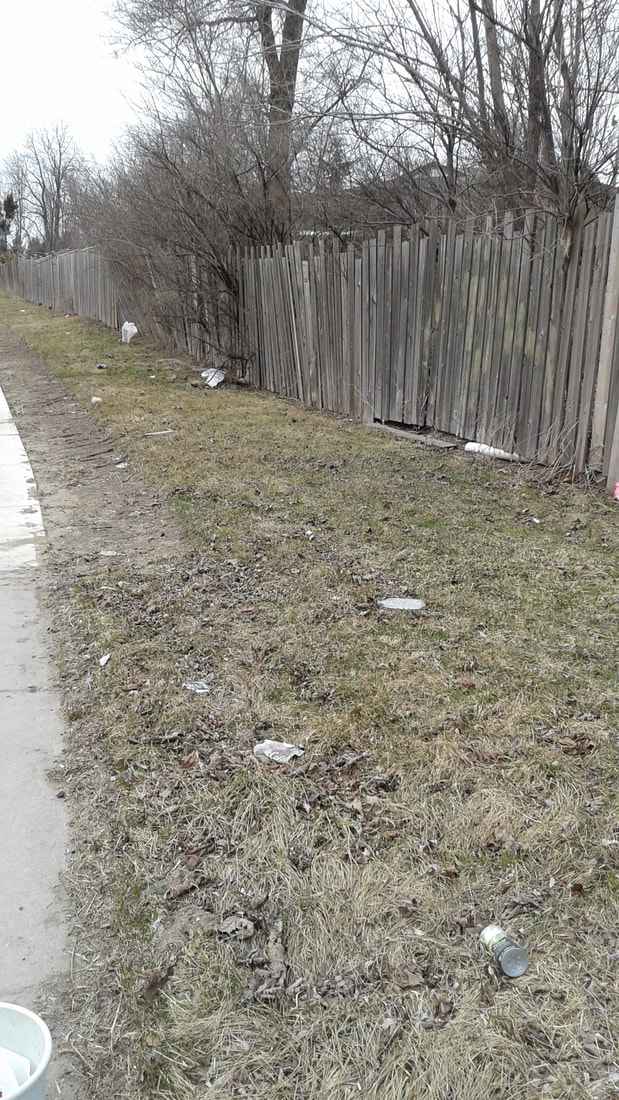
I couldn’t stand the sight a moment longer. So I took 90 minutes today to clean up a heavily littered area at the edge of my community in Toronto.  I grew sick of seeing plastic flapping in the trees and garbage all along the fence line and boulevard every time I drove by.

​There’s a bridge, a Highway 401 overpass, at the beginning of the strip of ground I cleaned. Now, when I say clean, I mean to the micro-level, every scrap captured no matter how small. As an experienced volunteer litter picker, very little escapes me. I didn’t go after cigarette butts. That would have required a separate endeavor altogether, there were so many of them.  Cellophane, foils and cigarette boxes were fair game though. Systematically I separated items that can be recycled from those that cannot. I collected other litter in a reusable sack and made three trips to the city litter bin near the transit shelter some distance away to deposit each load.

I had a big yellow garbage bag on the go too, stuffed it full of wayward large plastics, remnant plastic, coffee cups, tissues, paper wrapping and packing ties, cigarette boxes, snack and candy wrappers ...  You get the picture. This oversized large bag I hauled back home with me and I’ll use a pricey bag tag to legally place it out for the next curbside collection.  A great system, isn’t it, where a person has to pay to get rid of garbage not of their own making as well as donate the volunteer hours to clean it up in the first place?

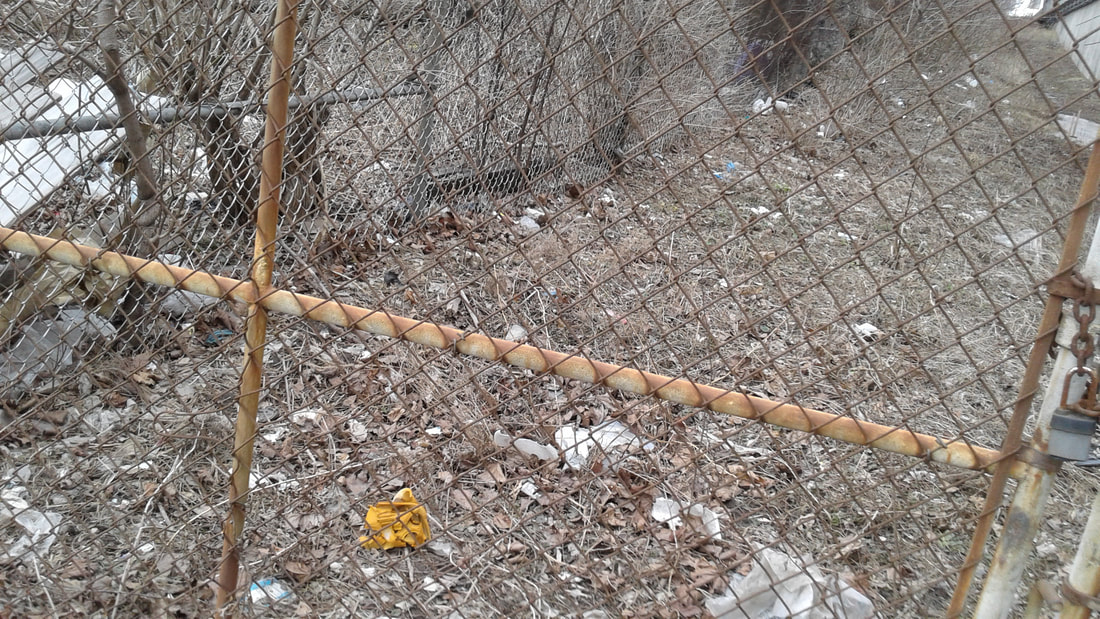
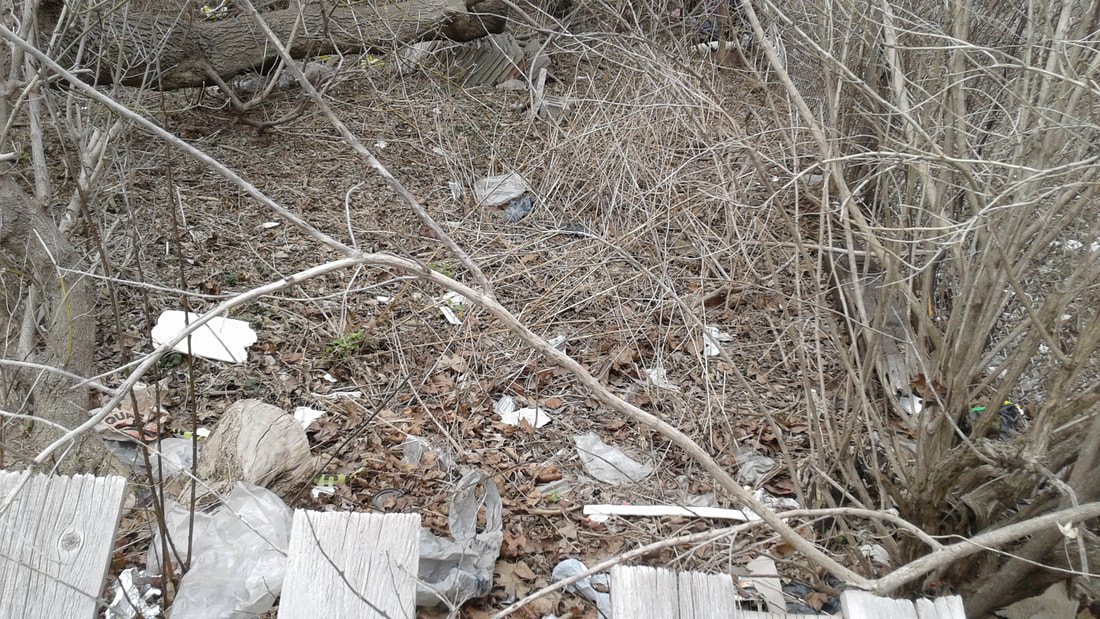
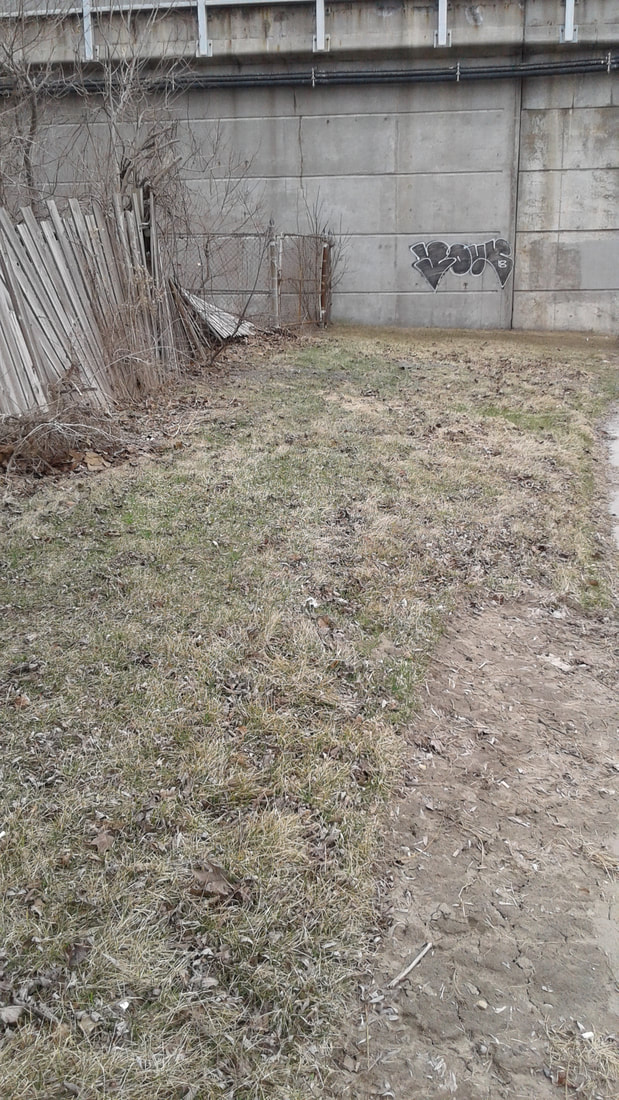
Back at the scene, abutting the base of the bridge, is a narrow strip of land running parallel to the highway behind a chain link fence.  Next to it is a parcel of land behind a broken down wooden fence.  The property doesn’t appear to be part of anyone’s backyard and it is awash with garbage that has come to rest there either through accidental or deliberate actions.  The area behind the fence did not receive the benefit of my tidying.  In my mind I could see this orphaned and neglected parcel converted into a beautiful open space and garden once cleared of its considerable trash.

The Province of Ontario owns the strip of land beside the bridge. I was able to get the private company that cleans up this section of the highway to do a special litter pick at this location last summer.  It was next to impossible to get it done and I was told it was a one-time-only deal because such cleanups were over and above the terms of the company’s contract with the Ministry of Transportation.  A ministry investigation determined the litter was not emanating from the highway above and concluded the area was adequately shielded from litter from raining down by a tall fence bordering that section of the highway.  I was told the origin of the area’s litter was at ground level, meaning from homes and businesses, passing cars, trucks, and pedestrians.

I wonder what would be the most effective way to convince them to take proper care of their waste and always use a “garbage can”?
0 Comments

I  make litter front page news

10/22/2017

2 Comments

 
I keep plugging away, week after week, churning out the headlines, following the trail, making a big deal out of the act of littering, no innocent deed, rather one that causes harm, injury and aggravation. Why does society bury this issue? I know that against natural disasters and the horrendous destruction caused by war the idea of littering as a problem may seem small, but that's no reason not to give it attention. People don't talk about the littering epidemic enough. I'm proud to be uncovering the dirt on littering, putting all these odd but important stories together in one place, hoping to convert a few littering people along the way. I make it easy for people to talk about litter. Every issue of my "Litterland" newsletter is a collection of conversation starters to help deliver the message that littering is wrong and unwanted all around the world. Subscribe. It's free. Share it. Post it. Use it to educate and do something to change littering behaviors. I make litter front page news because it matters. Stopping littering would be a huge win for the planet.
As a subscriber your copy of "Litterland" has active links to tools, backgrounders and resources. Below is the 237th weekly issue I've produced and you will find them all on this website.
2 Comments

Junk the jargon, bring in a real Waste-Free Ontario Act

3/7/2016

0 Comments

 
You know the people who say they “won’t bore you with the details”?  They lie.

Rather than do that, I will declare upfront: I might bore you with details. So unless you are interested in “Waste-Free Ontario”, stop reading right now.

In Ontario there is a law being designed to compel the creation of less waste from those who make consumer goods.  I had occasion to respond to Bill 151 before the public consultation process closed for this so-called Waste-Free Ontario Act on February 29. 

The legislation had recently received Second Reading. Politicians doled out opinions galore. But I felt they had missed something – a big something.  How can a bill that deals with waste in the Province of Ontario fall silent on the matter of litter?

If I haven’t lost your readership, here’s your chance to pretend you are the bureaucrat at the receiving end of the following submission.  Would you concede a point or two, or bury this brief at the bottom of a tall stack? (This is where a mustard-yellow flag may wave: ‘caution, may be boring’. My hope is for otherwise as
I unload onto you my Litter Prevention Program’s three-page online submission to the Ontario Ministry of Environment and Climate Change. 

Question, where would you rank litter as an issue – at the top or the bottom of the pile, or somewhere in between?

Reference: EBR Registry number 012-5834
Re: Bill 151, “Waste-Free Ontario Act”.

While laudable in its aims this legislation as written can never live up to its name.

I question the use of the term “end of life” waste in the legislation.  This is the loophole language that has enabled a significant segment of waste in Ontario to be ignored. What I’m referring to is litter, an unlawful behaviour that is pervasive and growing, evident to anyone who casts an eye to the ground while travelling highways and byways of this province. 

“End-of-life” has come to mean waste that is placed in a bin for recycling or disposal. The province of Ontario has no strategy for dealing with waste that is not at the end of its life. This is hugely problematic in an era when everyone from Pope Francis and Charles, through his Prince’s Trust, to the European Commission and EU is sounding alarm about the need for litter reduction and behavioural change.  How can Bill 151 be amended to address a longstanding omission to its waste management legislation?
Ontario producers, provincial agencies and the Ministry itself use the “end-of-life” jargon to excuse their lack of action on litter. Keeping in mind that total recycling equates to zero litter, and that 80 per cent of all litter in waterways had its origin on land, does it not make sense to go after this orphaned piece of the waste-free Ontario dream?

Existing laws in place to promote waste management best practices and bolster recycling rates in the Industrial, Commercial, Institutional (ICI) sector are not followed. 

I refer you to Reg. 103/94 2.1.3, more than two decades on the books and zero evidence of required practices ever having been put into play. 

To reiterate what was confirmed to this writer by the Ministry of the Environment several years ago, this is a legal requirement in Ontario.  Yet it is little known, routinely ignored and not enforced.  Quoting:

A Guide to Source Separation of Recyclable Materials for Industrial, Commercial and Institutional (ICI) Sectors and Multi-Unit Residential Buildings
As Required under Ontario Regulation 103/94
2.1.3 Information to Users
To promote awareness of the source separation program and ensure its continuing success, information must be provided to those who will use the program (e.g. employees, patrons, students and tenants).

This information can be in the form of yearly or more frequent progress reports that show the amount of materials collected, cost savings or other waste reduction achievements. These reports serve as reminders and motivational tools to encourage participation by providing feedback to users.

The program should be communicated to employees, tenants, students and patrons to ensure that source separation procedures, responsibilities and equipment use are properly understood. New employees should also be informed of the program and trained in its operation as soon as is practical after being hired. Also, information about modifications to the program, such as the addition of new materials to be separated, must be conveyed. Communication can be through newsletters, signs, group meetings or other methods available to the owner or operator.

Employees should be trained in the proper use of source separation equipment and program procedures. Training should enable employees to recognize what materials must be source separated, the desired quality, locations of collection containers, and how to contact program coordinators. Training can take place through meetings, information sessions, newsletters or pamphlets.  End quote.
 
The point I’d like to make both about the abovementioned regulation and the proposed Bill 151, legislated directives for better waste management are meaningless without follow-up: scrutiny and enforcement that is vigilant and well-communicated along with budgeted resources for funding reasonable measures for the initiative’s success.

Case in point: Had the ministry budgeted for a program to ensure that ICI partners had filed their annual reports at least once a year since 1994, the public would be far advanced in its understanding of the importance of using bins for waste.  Education and awareness do result in higher recycling participation rates and litter level reductions.  It can be argued that Ontario’s diversion rates would be much higher than where they stand today, at 25% overall and 13% in ICI.

It appears that Bill 151 offloads enforcement to a third party. This removes a level of direct accountability that the public deserves to have. Implicitly, a citizen should have direct link to the enforcement arm through government to have breaches to the Act investigated and a certain transparency to the process.
The public needs a clear reporting line to the proposed new oversight body, the Resource Productivity and Recovery Authority, deemed responsible for enforcement. 

Turning attention to Section 70, then, an opportunity exists in Bill 151 to promote and educate.

Responsibility for promotion and education
   70.  (1)  For the purpose of increasing the collection, reuse, recycling or recovery of material in a designated class, a regulation may provide that a person mentioned in section 61 or 62 is responsible for implementing a promotion and education program in respect of the collection system or management system for that class in accordance with the prescribed requirements.
   (2)  For the purpose of increasing the collection, reuse, recycling or recovery of material in a designated class, a regulation may provide that persons performing an activity that relates to resource recovery or waste reduction in Ontario other than a person described in subsection (1) are responsible for implementing a promotion and education program in respect of the collection of material in a designated class in accordance with the regulations. 

I believe these sections of the bill should be a requirement -- non-discretionary. This regulation should be crafted so as to ensure that there is absolute follow-through.  The language in 70 (1) indicates a regulation may provide for this, but does not say “shall” provide.  That in itself creates wiggle room enough to possibly replicate the inert status of Reg. 103/94 2.1.3 where promotion and education failed to materialize.

Among questions prompted by Bill 151, will the legislation be sufficient to hold tobacco companies responsible for cigarette butt litter, chewing gum manufacturers for gum litter strategies, waste management companies and haulers for flyaway litter escaping their cabs, people and corporations from dumping? Will there be education concerning the proliferate tossing of coffee cups, lids, straws and bottles?

Tobacco is federally regulated. How will tobacco manufacturers be bound by Bill 151?  Will they be “required to implement a promotion and education program in respect of the collection system or management system for that class in accordance with the prescribed requirements”?

The goal of achieving a circular economy and waste-free society in Ontario hinges upon the availability of sustained education for all age groups.  Despite this province’s extraordinary Blue Box infrastructure and introduction of the 3R approach 35 years ago, participation rates remain tepid and flat. That’s why a Section 70 with teeth is crucially important to the success of this legislation.

Again, moving to a waste-free culture demands that we deal with waste that defies the “end-of-life” definition. The Ontario Legislature should engage itself in the issue of waste that is not at the “end-of-life” as the British Parliament did last year when it held committee hearings, fact-finding and outreach for UK’s Litter Inquiry.

Witness Belgium’s recent pledge, aiming to have 20 per cent less litter by 2022 compared to 2014 levels. In Belgium (population 11.2 million) producer groups are committing to fund a national litter prevention program, estimated by Clean Europe Network to be worth about €17 million annually.

Bill 151 can be viewed as an excellent beginning.  One would hope to see a committed time frame for the implementation and meeting of all objectives, and public reporting on an ongoing basis.  Shown below in italics are my responses and questions re Bill 151’s objectives. 

Divert more waste from disposal by
collecting data and putting performance measures in place to enable the province to make evidence-based decisions and measure progress towards zero waste, including a litter audit and provincial litter index
using disposal bans to facilitate resource recovery and waste reduction;   Study the impact of disposal bans and fee hikes on dumping rates

 integrating multiple tools to foster collaboration allowing parties to work together to deliver a seamless system, to include  an umbrella Keep Beautiful or Keep Clean agency to deal with non-end-of-life waste.
Helping people reduce, reuse and recycle and not litter by increasing awareness of and participation in diversion activities through education and promotion.  A must-do.  (Who will be responsible for approving education and promotional activities aimed at increasing awareness?)
Stimulating markets for recovered materials by implementing modern environmental standards; and demonstrating provincial leadership through green procurement and undertaking litter prevention education and broader recycling of products within government ministries through Ontario companies such as TerraCycle.
 
In closing, I submit that:
  1. The bill should be subject to public hearings to receive more input and promote greater awareness.
  2. The term end-of-life waste in the bill is problematic and needs to be addressed.
  3. Education and promotion must be required  by the legislation, not a discretionary item.
  4. Ontario should lead in the establishment of a review of non-end-of-life waste.

Still with me, friends? Thanks for reading!  - Sheila
0 Comments

Shooting for the NBA All-Star basket in more ways than one

1/13/2016

2 Comments

 
Imagine this: An anti-litter campaign married to a big-time sporting event in one of the world’s greatest cities. 
 
The NBA All-Star game hits Toronto in February for the first time.  Is there no more natural a union for litter prevention than with a sport that involves putting something in a basket? 
 
McDonald’s tried a two-week advertising campaign in Germany some years back in connection with world soccer: Same idea, different sport.  It reaped results, a 62 per cent increase in bin usage over the course of the promotion. 
 
Scotland linked its national anti-litter initiative to the 2014 Commonwealth Games it hosted in Glasgow.
 
For Toronto, Ontario, where littering behaviours are prolific and frequently go unchecked, this is an opportunity to target a demographic associated with littering.
 
An anti- litter campaign/contest would benefit everyone.
 
The All-Star basketball event has all the right elements for a superb awareness push: sports celebrities, corporate sponsors, a major league with an established fan base and social media channels, TV opportunities, community engagement possibilities, and an unbeatable theme, a natural tie-in: “Put It In The Basket”.   It presents the chance to involve partners like beverage, fast food, confectionery, packagers and others whose products contribute to the litter stream.

Other places hold little prevention contests, everything from trash can-painting for kids in Montana to online slogan searches in Australia.

Texas just gave away a car as part of a statewide anti-litter sweepstakes. University of Northern Tennessee student Justin Truby, of Denton, received the keys to his 2016 Ford Fusion SE Hybrid during a Dallas Cowboys - Washington Redskins game in front of a hometown stadium crowd in Arlington on January 3. It was a big deal, done to mark 30 years of “Don’t Mess With Texas”, a celebrated anti-litter campaign.
 
In Ontario government circles, there exists not the faintest inkling of interest or infrastructure for tackling littering behaviours and reducing the amount of trash people throw on public lands.
 
Special events come and go, and it seems what the politicians most care about is rubbing shoulders with the who’s who, getting free stuff, glad-handing, and crowing in the media and on Twitter.
 
When it comes time to do something really meaningful around litter, you won’t find those decision makers anywhere around.  And that’s unfortunate. Influential voices encouraging the people of Toronto to use a ‘basket’ for litter is something we don’t hear enough of.  

Done right, a campaign during the NBA-Fest would be equivalent to a slam-dunk for litter prevention.

2 Comments

My first day off in more than 1,000 days

11/2/2015

1 Comment

 
More than one thousand days, that’s how long I have been scanning the global internet to find stories about littering. Daily, consecutively, I and my mug of tea have been regular and constant companions in a search for the key to solving society’s unyielding litter problem, mining for litter stories and always finding plenty, until today.

For the first time in 1000+ days there is no pay dirt. Mark November 2, 2015 in the litter history book, the first day in more than a thousand that not a single litter story has surfaced from any corner of the world.
Now that doesn’t mean nobody littered. (I wish.)  It just means yesterday was Sunday, a slow news day, rare and therefore remarkable.  Tomorrow the litter news tap will flow again when today's reports reach my feed.

In the vague distance I can almost discern the sound of mumbling voices saying, “Get a life!”
But I swear litter is an important topic that requires monitoring on a global scale as well as personally and locally.

Had I not the interest in littering and a passion for bundling this news for broader consumption, I would have missed some landmark stories this week. The landscape of litter policy is a moving target – always something to shoot at.

I would not have known, for example, there now exists a free guide for food service establishments on tackling litter, a joint project of Keep America Beautiful, National Restaurant Association, and the National Packaging Association.  Give one of these to every food seller, vendor and restaurateur.
I would have been unaware of a national legislative change in Bolivia that promises to come down hard on people who dump and litter.

I wouldn’t have known about the launch of the world’s first open online university course on marine litter (MOOC), a UNEP-backed initiative.

Nor would I have known about the latest marine litter studies that alert us as clear as warning buoys: plastic litter is imperilling the ocean’s health - a priority problem that must be addressed.   I don’t care whether it’s Hong Kong, the Great Barrier Reef or the remote Barents Sea in the Arctic, research is all pointing to the same conclusion.

We need to get a grip on litter.

1 Comment

"Kids: Clean is the new dirty"

6/18/2015

0 Comments

 
Just because I have not been blogging doesn’t mean I don’t have litter on my mind every single day.

Some seem not to notice garbage strewn about on grass and paths. Through the litter lens remnant trash is unmistakable and undeniable.  The adolescent generation, in particular, seems not to care about littering.

I visited three schools serving my neighbourhood. If my broad, sweeping and wholly unscientific assessment of the schoolyards is any indication, the breakdown in litter awareness occurs as children enter high school.

The junior public school grounds were spotless.  Similarly, our senior public school was not only cosmetically appealing, but free of litter as well, except for a scrap here and there in the parking lot.

Over at the secondary school an entirely different landscape meets the surveyor’s gaze.  Ironically, on our way to deliver a donation to express the community’s thanks for the handful of students who volunteer for us, the front lawn area is a neglected mess.

Of course I picked up what I could. There were two of us, one to deliver the cheque to the door and one, as it turned out, to stay behind and observe.

A tri-sorting waste bin sat steps away.

I noticed the student perched on a ledge buried in her phone, oblivious to anything I was doing.  First I picked up and bagged eight bottles and one can.  These I put in the compartment for recycling. I always try to have bag or two on hand to use for litter retrieval.  In this case my bag worked well to hold the many plastic cups and food related containers. Thankfully there were seven or eight unused Pizza Pizza paper napkins that served as hand wipes and which I composted at home later.

Apparently all Toronto District schools use the Green Bin now for organic composting. Maybe that’s just in theory because there was no immediate place for compostable food waste and wrappers.

I put the garbage in the section where a now-faded sign once had clearly indicated it was intended for litter.  I removed two lidded plastic cups with straws and liquid still inside that were wedged in the section of the bin marked Newspaper and redirected them all the way into the litter bin.

How stupid are these kids?  I ask myself, and what’s wrong with the system that’s producing them?  They are the reason the litter problem has grown so much worse.

This week a study attempted to explain the litter gap in youth by attributing the growth in littering to an increasingly narcissistic generation of young people marked by inflated feelings of self-importance (often a convenient mask for low self-esteem.) 

Rightist website conservativehome.com picked up on this point and linked it to littering in an excellent article by Peter Franklin:
Heresy of the week: Litter, self-esteem and why we could do with less of both 

I never thought I would find myself agreeing with any opinion from the online “home of conservatism”, but on littering I do.

Author David Brooks describes a surge in self-absorbed feelings among youth today versus 50 years ago in his recent book “The Road To Character.”  It’s not a far leap to suggest this has spawned a litter gap generation of 18-35 year olds in the 21st century.

“The proportion of American teenagers who believe themselves to be ‘very important’ jumped from 12% in 1950 to 80% in 2005. On a test that asks subjects to agree or disagree with statements such as ‘I like to look at my body’ and ‘Somebody should write a biography about me’, 93% of young Americans emerge as being more narcissistic than the average of 20 years ago…” Franklin quotes Brooks. 

As studies both in the US and here in my Toronto hometown verify, recycling and the whole notion of responsible stewardship of waste has failed to catch on with these up-and-comers.  It’s the older set that’s recycling.  Where did we as a society go wrong?  Somewhere between senior public and secondary school we failed to instill the non-littering habit as an unshakable core value.  Perhaps we should begin indexing and ranking properties for litter levels as they do in nations like Australia and Ireland.

At some point we lost the compass that could lead us out of the woods.  We failed to appeal to youth in a way that appealed to them, evidently.  Those who try, like my friend Elijah Mensah at the non-profit Help Change Ghana, should be heeded, supported and applauded.

I just want to say, “Hey, kids: Clean is the new dirty.”
0 Comments

Ghana has a lot to learn from this man

4/22/2015

4 Comments

 
Tweet
Oceans can’t separate those who share the goal of a cleaner planet.

From Canada to all other parts of the world the men and women who stand against littering are like-minded tributaries, all feeding the same inspirational source.  Each for their own reasons has been driven to care about this environmental issue.  I am amazed at how the cause connects us no matter where we live.
Picture
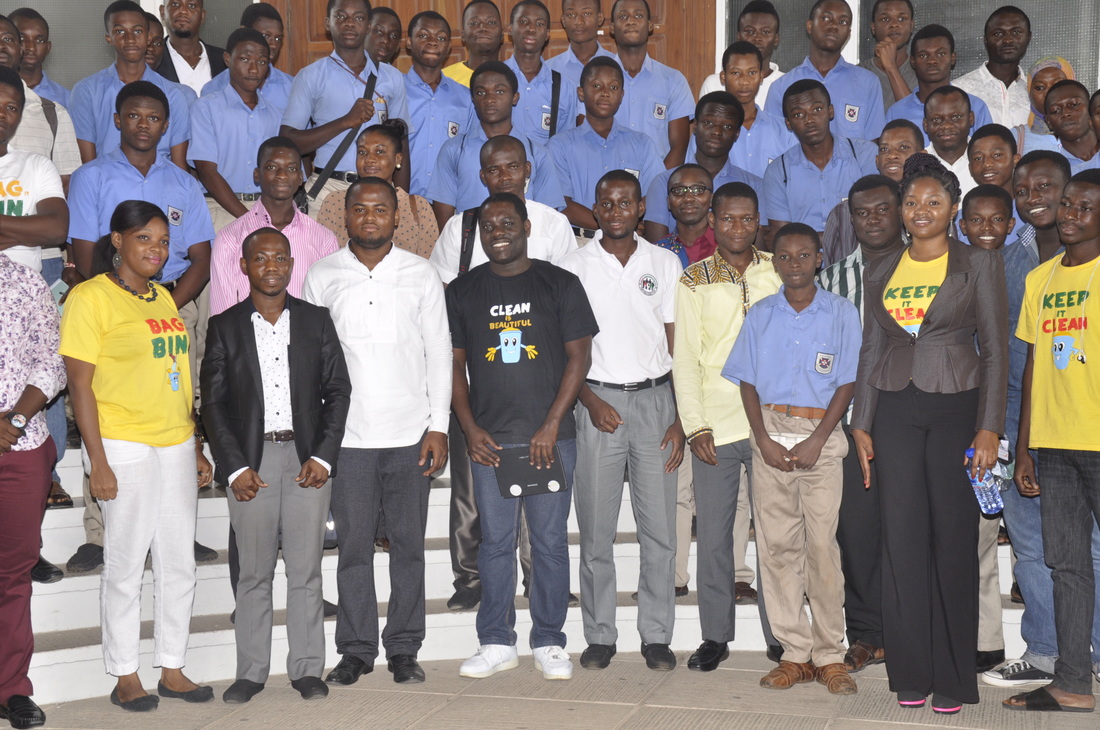
If not for the Internet I probably would not know Elijah Mensah, a remarkable young man from Ghana, who found me online and sought me out for ideas and advice.  He is the driver behind Help Change Ghana and the Youth Litter Prevention Program that is trying to propel a massive cultural shift across the African nation. It is slow going, one person at a time.  But Mensah, at 29, has managed to pull together an indefatigable team of young people and $5,000 of his own money to start to put a stop to littering in a country steeped in it.

“In building a greater understanding on the need to keep away from filth and maintain a healthy environment, Help Change Ghana - a non-profit organization dedicated to the development, expansion and promotion of environmental sanitation through composting, reduction, reusing and recycling of waste - organized a two-day Youth Litter Prevention Campaign dubbed “Stop the drop, because you can,” Elijah tells me when we speak via Skype.

I ask him to send me a synopsis so I can chronicle what he's doing. 

“Our campaign commenced with field education in three tertiary institutions on some harmful effects of littering,” Mensah writes. “A rousing symposium was held on the second day at the University of Ghana Business School.  Close to 150 participated from the university community and heard keynote speakers from the Accra Metropolitan Assembly, the EPA, Local Government and rural development and the Zoomlion Waste Management Limited.  

“The participants took a pledge to stop littering and protect the environment. There were opinion polls, which many supported, saying the city authorities should sanction and fine litterers.

“Help Change Ghana is working to petition city authorities to make sure the law against littering is duly adhered to, so as to, not only prevent situations like epidemics, but floods especially.”

He tells me that while littering is a criminal offense punishable by law with provisions for fines and prosecutions, he estimates “90 per cent” of Ghanaians litter, and that throwing litter from a moving vehicle is perhaps the most common sin.

Litter choking drains is a major cause of flooding in Ghana. Help Change Ghana grapples with a problem common to the world, and is determined to convert litterers to non-litterers one citizen at a time.
While we are, literally, oceans apart, Elijah and I ride the same wave.
4 Comments

Butt Blitz May 2 A Canadian First

4/17/2015

1 Comment

 
Tweet
Here's a litter-related news scoop: Butt Blitz, a day when Canada gets its butts up off the ground.

On Saturday, May 2 Canadians are being called upon to pick up littered cigarette butts in a first-time, national drive to retrieve high volumes of the country’s most littered item. Coordinators coast-to-coast are signing up to receive and tally butts before sending them all to be recycled.  Find out more and register as a coordinator or collector at www.agreenerfuture.ca.

Butt Blitz is a partnership involving A Greener Future, Envirocana Inc. and TerraCycle Canada – an inaugural  Canada-wide effort to stub out what is unquestionably the most toxic form of small litter, the virtually indestructible plastic filter of a cigarette.

Sixty-five per cent of smokers are likely to litter cigarette butts rather than adopt a responsible smoking and disposal plan every time they smoke.  Somehow, from lack of instruction and lack of communication, flicking butts came to be a routine method of disposal, part of a beginning smoker’s learning to smoke ritual, part of the “experience” he or she carries through their smoking lives.

Vancouver Aquarium Great Canadian Shoreline Cleanup has offered up promotion for the event.  Butt Blitz is tailor made for public participation, in fact, relies on it. 

The collection day is a wonderful start to raising awareness and gaining community cooperation for strategies that stand not only to reduce butt litter, but reprogram the behavior of butt litterers, those people we know as smokers.

It’s time for the anti-cigarette butt people - and that 35 per cent group of non-littering smokers - to stand up and be counted.  May 2 would be a good day to start.
1 Comment

Ten Ways To Fight Climate Change

1/21/2015

1 Comment

 
Carbon emissions, villains of the world’s unfolding climate change drama, need curbing.  What are you willing to do to aid the effort?

Most people want to kick the problem upstairs, have the corporations and governments make big moves to scale back the ozone-eating agents that scientists say threaten the planet’s survival.

What if the answer to climate change rested more on the backs of each individual?  No more fobbing off to the untouchables - the legislators and corporations. 

Here are ten ways to fight climate change.  But how far is one willing to go in the real world of consumers and their passions?

1. Don’t use a drive-thru for banking, fast food or coffee.
2. Chuck the car (or use it way less).
3. Say ‘good-bye’ to the two-stroke engine.
4. Keep your home air conditioning off unless heat is truly stifling.
5. Don’t idle your parked car to keep it cool for a passenger while you do errands.
6. Offset your airline flights by paying a carbon surcharge.
7. Turn lights off when you leave the room. 
8. Write a letter to a polluter or the editor of a newspaper.
9. Stop littering or never litter so that all waste materials are recaptured for responsible recycling, negating the need for using as many virgin resources in manufacturing.
10. Don’t sleep with the television on.

Every individual possesses the power to show a true willingness to fight climate change.  Beyond the marches, protests, high-level discourse and efforts to hold large corporations and our governments to account, simple day-to-day actions taken by each of us compound to make the most profound difference.  
1 Comment
<<Previous
Forward>>

    Author

    Creative communications consultant Sheila White is founder of the Litter Prevention Program, and prior worked as a communications ace and PR strategist for some of Ontario's top political names.

    Archives

    June 2024
    February 2024
    September 2021
    May 2021
    July 2020
    January 2020
    June 2019
    May 2019
    April 2019
    October 2017
    March 2016
    January 2016
    November 2015
    June 2015
    April 2015
    January 2015
    December 2014
    September 2014
    August 2014
    May 2014
    April 2014
    March 2014
    February 2014
    January 2014
    December 2013
    November 2013
    October 2013
    September 2013
    August 2013
    July 2013
    June 2013
    May 2013
    April 2013
    March 2013
    February 2013
    January 2013
    December 2012
    November 2012
    October 2012
    September 2012
    August 2012
    July 2012

    Categories

    All
    Advertising
    Art
    Canada Post
    Education
    Entertainment
    Environment
    Litter
    Litter Prevention
    Psychology
    Recycling
    Religion
    Rob Ford
    Tobacco Litter
    Toronto
    Waste Management

    RSS Feed